Posts

After the Rain – Episode 7
Image
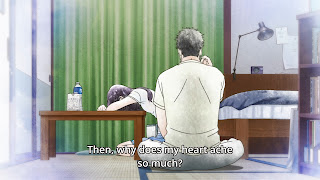
Distinctly manipulated lighting and shadows, fog and smoke effects, rain, stylized use of contrast and desaturation, and a myriad of image processing – these are often used to create visual textures that can capture a mood, an atmosphere and a certain emotional tone. Visual textures definitely tell a story but often a singular one strongly befitting a scene or even an entire movie. What stood out in this episode of After the Rain is the use of visual textures as a narrative device in an almost shot by shot basis. Various visual textures were used to accentuate the characters’ emotions and to mirror the dialogue. After a tense interaction with Kondo in which he said (to Tachibana), “You know nothing about me,” the characters then faced their emotions in Kondo’s apartment. The scene started off neutral in terms of lighting, color and texture. When the two started to express their feelings more, the visual texture changed to reflect the emotional shift. The above screenshots sh...

Koe no Katachi (A Silent Voice)

Both in the beginning and towards the end of Koe no Katachi there’s a fundamental scene where Ishida walks in the school hallway in anxiety while avoiding eye contact with his fellow students. The key difference between the two scenes is that the first one was done in a subjective point-of-view while the last one in an objective point-of-view. The difference in POV was to visually accentuate the contrast in narrative between the beginning and the end. Subjective POVs are usually shot in first person perspective and this is exactly how a large portion of the first “hallway scene” was shot. In this POV the audience sees the world from the character’s eyes, a far more visually and emotionally engaging experience. The viewer is in Ishida’s shoes as he walks through hallway, nervously looking down at the ground and avoiding the faces of other students. The camera shakes and moves unevenly. This motion of the camera not only emulates Ishida’s movement but also highlights his discomfor...

Hibike! Euphonium S2 - Episode 9

Image
There was a part of the episode where Asuka opened up about her mother and described her as crazy, possessive and hysterical. These are words with strong negative connotations and yet Asuka uttered them in a nonchalant and cold manner. She even rationalized that she didn’t hate her, as if putting on a façade. Fittingly her dialogue was shot as a direct overhead shot. This type of shot tends to be flat and minimizes perspective lines. This visual, depending on context, can feel cold, sterile and unengaging. The coldness and sterility of this visual captured her tone and demeanor. The unengaging flatness accentuated the sense of disconnect presented by her façade. Overhead shot Kumiko saw through this façade and didn’t mince words. She immediately insinuated that Asuka actually hates her mother despite her calm and carefree demeanor. The façade was broken as reflected by the drastic transition from the unengaging overhead shot to the more emotionally engaging close-up and extre...

Hibike! Euphonium S2 - Episode 3

Image
The beginning of the discussion scene between Kumiko and Asuka purposely broke the 180 degree rule in order to build tension. The 180 degree rule is designed to maintain the camera on one side of the line of action so that the subjects stay on their side of the frame consistently. This is done for visual continuity, which makes it easier for the audience to follow the scene. The rule is broken when the camera jumps the line and the subjects suddenly switch sides on the next frame. There are times the rule is broken for either practical or narrative purposes. The scene between Kumiko and Asuka broke it for the latter reason. The characters switching sides multiple times created a subtly disorienting and jarring visual that enhanced the tension of the scene. This disorienting visual also reflected Kumiko’s feeling of unease and nervousness throughout the entire exchange. 180 degree rule broken: Asuka on the left side in the first then switches to the right in the next shot. Th...

The Case of Hana & Alice

When the camera moves it’s always good to have a reason behind it whether it’s practical or narrative driven. Camera movement with perspective changes is even more dynamic in traditional animation since it’s a lot rarer. This rarity makes the camera move a powerful visual storytelling tool and The Case of Hana & Alice made use of it to a great effect. The Case of Hana & Alice is a story about two teenage girls dealing with significant changes in their lives. The movie conveyed these changes through camera movement and perspective changes. Horizontal tracking shots were utilized as a visual metaphor for the pivotal transitions in the story and the characters’ development. The rare perspective changes in these shots aided in giving more emphasis to the visual metaphor. The first horizontal tracking shot of the movie is Alice and her mother walking to her new school. Transferring to another school comes with the challenges of getting to know new people, getting accustomed ...

Beautiful Bones -Sakurako's Investigation- Episode 7

Image
During the conversation about Sakurako’s autopsy of her pet cat, there was a sequence of close-up shots that only partially framed the face or didn’t show it at all. This practice is quite common in anime, especially during dramatic moments. I think these are done for an effect. Watching a dramatic exchange without seeing the character’s face is visually odd and uneasy, which is an effect that can add tension to the scene. Another effect of these types of shots is they put more emphasis on the voice acting and body language, which at times might be a more effective emotional stimulant than facial expressions. The aforementioned reasons for these odd and uneasy shots hold true for this sequence in this episode but they also match the mood of the conversation. The visually uncomfortable framing accentuated the naturally unsettling idea of dissecting a pet, an idea that really bothered Shoutarou. There was also a tension between two differing personalities that this odd ...

Beautiful Bones -Sakurako's Investigation- Episode 6

Image
The major conflict in this episode was the differing beliefs between Yuri and Isozaki about the issue of suicide. After failing to find the woman they assumed to be suicidal, their disagreement came to a head at the river bank. I thought the visual storytelling in this scene was effective at displaying the conflict, understanding and compromise between the two characters. Low Angle High Angle The first set of visual devices was the commonly used high and low angles. What made the high/low angle usage in this scene a bit different than the usual was it switched on the characters. These switches were narratively driven but also done in practical manner which made the switches feel natural. If you rewatch the sequence above it starts with Isozaki at the top of the steps and Yuri at the bottom. From a practical sense in order to account for differing elevations of the characters, a low angle was used on Isozaki and a high one on Yuri. Even after Isozaki came down the...

OWARIMONOGATARI Episode 5 – SODACHI Lost, Part 2

Image
In this episode the side view wide shot of Araragi and Oikura was used repeatedly in order to function as a constant for the lighting changes. This made the changes in lighting more perceptible, which helped it visually convey the changes in the mood of Oikura. The first shot was in the beginning of the episode. This shot was at its brightest, which matches the relatively less serious start. As Oikura reveals more about her dysfunctional family, the lighting became dimmer and the shadows heavier which accentuated her state of misery. The third shot was especially apt, since at this point she was describing Araragi’s happy family as so bright to the point of being unsettling.   The contrast between her description of his family and the dimmed room visualized how comparatively miserable her family life was. In this second sequence of shots it again started off bright although not as bright as the first couple of shots. At this point she was still using A...

The Portrait Studio

The Portrait Studio is a short by Takashi Nakamura that chronicles the shared life experiences of a little girl and a photographer. It begins with a young couple visiting the studio for the wife to get her portrait taken. Later they return with their baby daughter who always looks grumpy. The jovial photographer futilely tries to coax a smile out her; he does so again and again every time the little girl returns. As time passes the two of them share important personal moments and witness historical events. As you watch the film what becomes apparent is the use of visual repetition. Specifically the repeated visual motif of the wide shot of the photographer’s house and the stairs leading up to the house. Also, throughout the short the house and stairs barely change. The lack of change combined with the repetition establishes them as visual constants. By having constants to contrast against it made the changes that occur in the characters and the setting more dramatic and striki...

Fade

Image
As the sun begins to set it brings the warmth of different shades of orange and red but what follows is the night which tempers this warmth. The appreciation of this little daily life occurrence is the essence of this short film Fade . The sunset was blissfully brought to life with clever usage of shadows and color changes. Watch the short film below: ________________________________________________________________________ The first two shots of the short were establishing shots with a nice cold and warm color contrast. The visual contrast of the night creeping in and the warm light of the sun slowly receding immediately expressed the central idea of the film. The floating balloon and the strips of orange and red that followed quickly engaged the viewers’ eyes to lead it to the direction of the sunset. It’s a subtle preamble to the main action of the film which is the chase of the sunset. The liveliness of the sunset was best expressed by the playful use of shadows...

Hibike! Euphonium - Episode 11

Image
In the audition scene there were a few subtle changes in the camera movement in order to differentiate the performance between Kousaka and Kaori.   The clip below is a side by side comparison of their performance. The camera work in Kousaka’s performance was more dynamic which gave her a superior presence as a performer. This of course supports the notion that she’s the better musician. The first example is when the camera pulled back from an extreme close-up of their eyes. In Kousaka’s performance the camera pulled back farther and faster. As you’ll notice in the shots above, for Kaori the camera pulled back to a medium close-up while for Kousaka it pulled back farther to a medium shot. Another difference is the shot size of the concert hall during their performance. The first image above is a wide shot of the concert hall when Kaori was playing and the second image is an extreme wide shot of it during Kousaka’s performance. The extreme wide shot gave Kousa...

Hibike! Euphonium - Episode 8

Image
During the festival Kumiko and Kousaka decided to go hiking which lead to a beautifully executed scene of the two characters sharing a moment that cemented their friendship. The most apparent visual aspect of this scene was the strong usage of lighting on Kousaka in comparison to Kumiko. The lighting on Kousaka made her look ethereal and created a sense of reverence that epitomized her desire to be special. Another visual aspect in this scene that was not as conspicuous as the lighting was the meaningful use of the city lights backdrop. It was used to both differentiate the characters and connect them towards the end of the scene. The city lights backdrop were used for Kousaka’s solo shots, while Kumiko’s were set against a dull background. This contrast in vibrancy formed a perception of differing personalities between the two. The colorful city lights reinforced Kousaka’s ambitiousness. The bland background complemented Kumiko’s understated and reserved nature. ...

Hibike! Euphonium - Episode 5

Image
To Kumiko high school is a new beginning, a way to make new friends and perhaps to experience the concert band club in a more gratifying way. In the scene where Kumiko gets reacquainted with an old bandmate, her pursuit for a new beginning was demonstrated in a way that earnestly expressed her feelings. When Kumiko was invited to meet with other former bandmates, she stopped and looked back at her new band club and new friends. As Kumiko looks on you might notice a slight shaky cam effect and shimmering movement in her eyes. The shaky cam and shimmering effect were obviously done for dramatic effect but more importantly the similar movements visually connected the close-ups of Kumiko and the shots of her new bandmates. This visual connection conveyed her attachment and commitment to her new bandmates and to this new experience. The sequence above is when Kumiko finally told her old bandmate that she attended Kitauji to have a new start. This sequence made use ...