Posts

Showing posts with the label Shigatsu wa Kimi no Uso

Shigatsu wa Kimi no Uso (Your Lie in April) Episode 21

Image
This was quite an emotionally heavy episode. The moments that emotionally stood out were the Kousei-Hiroko and the rooftop scenes but what really caught my attention was the hospital room scene between Kousei and Kaori. This scene effectively used framing and other compositional elements to create a distant mood that then shifts to one that’s more intimate. The scene starts off with an awkward and detached mood. Kousei avoids conversation and eye contact to distance himself from the pain of seeing the deteriorating health of Kaori. The two “two shots” above reflect this feeling of detachment. The three-quarter angle shot (first image) and the wide shot created distance between the two characters that conveyed a feeling of disconnect. This feeling of disconnect was further reinforced with the use surface division and dividing lines that visually separated the characters. The three-quarter shot staged Kousei against a white surface while Kaori was against a brown one. The wide...

Shigatsu wa Kimi no Uso (Your Lie in April) Episode 18

Image
This episode’s performance was a terrific coming of age for Nagi as a musician cross cut with Kaori’s bitter sweet violin pantomime. From a cinematography stand point, the performance scene mixes up the camera work in order to match the change in mood. The beginning moments of the scene were filled with slow pans, tilts, and tracking shots. These languid movements matched Nagi’s feeling of comfort and ease with her performance. For Kousei this wasn’t good enough and looked to push her further as a performer. He shifted the mood and tone of the performance and accordingly the camera work matched up with it. There were less camera movement and more low angle static shots of Kousei that gave him a more commanding presence (as seen below). This was a nice use of whip-pan to emulate Nagi’s willingness to keep up with Kousei’s pace. It appropriately expressed Nagi’s intensity but it was also brief enough not to be a distraction.

Shigatsu wa Kimi no Uso (Your Lie in April) Episode 10

Image
The cold intro was my favorite moment of this episode. As beautiful as the aesthetics of this show can be a times with its vivid imagery and stylistic close-ups, the constant usage can dilute their effect. Low key moments like this cold intro function as a breather from both a visual and pacing standpoint. It’s just a plain scene of two friends having a conversation while walking home from school. This simplicity allows the characters’ actions and dialogue to speak for themselves, such moments can even provide a purer sense of sincerity. The scene starts with a tracking shot of electric lines as Watari laments his delayed journey to stardom. Then it cuts to panning cutaways of the street. Without even showing the characters the scene establishes what’s happening. We know they’re walking due to the tracking shot and we know their surroundings due to the cutaways. Also, by not showing the characters it slows the scene down for the intended subdued effect. The c...

Shigatsu wa Kimi no Uso (Your Lie in April) Episode 8

The camera work used for Takeshi’s and Emi’s performances differed from each other in order to present their differing play style and motives. Even though both share a similar desire to overcome Kousei, their approach was different and the camera work reflected that. Takeshi’s performance was an exhibition of technical excellence and skill; facets where he’s trying to surpass Kousei. The performance had a confrontational and competitive feel to it. To convey Takeshi’s competitive spirit, much of the camera work were zoom in/push in shots that put more focus and attention on his intense performance. While Emi’s is also trying to surpass Kousei, her performance was less about competing but more about reaching out to Kousei. She wants the old Kousei back, the one who played with emotions and inspired her to become a performer. Emi is a performer that wears her heart on her sleeves and through this she uses music to send an emotional message to Kousei. This is reflected by the...

Shigatsu wa Kimi no Uso (Your Lie in April) Episode 6

Image
This show continues to use lateral tracking in interesting ways. There was the Kousei tracking shot in Episode 2 . Then, there’s the tracking shot of Tsubaki in Episode 5 that made use of the lateral movement as a wipe transition to a brief flashback. In these tracking shots both characters lack nose/lead room and the framing is obviously unbalanced. The lack of balance is uncomfortable to look at. For this scene it was meant to be that way in order to convey Tsubaki’s uncomfortable realization that Kaori’s usage of “we” did not include her with Kousei. Also, notice how the two are framed at opposite sides to each other and in the overlay (third image) of the two shots they’re facing away from each other. The mismatched visuals of the two reflect their incompatibility and Tsubaki’s lack of feelings for him.

Shigatsu wa Kimi no Uso (Your Lie in April) Episode 5

Image
This episode had many captivating moments that pull you into investing yourself into these characters. These moments were primarily constituted of effective use of unbalanced framing, tight/extreme close ups and timely insert shots. The Hospital Scene The mini-flashback starts with an insert shot of Kousei pressing the piano key. This drives the point that he did try playing but still unable to hear his own music. The extreme close up of his eyes is to show him envisioning his performance with Kaori that he wants to recreate. Another insert shot of his finger hitting the key shows how out of reach that moment is. Seeing him repeatedly hitting the key only to just hear a thud adds so much melancholy to this sequence. The extreme close up of his ear is a visual of the sound of the piano not reaching him. All of these insert shots and close ups serve as emotional build up to when it finally cuts to an evocatively sad full-shot of him covering hi...

Shigatsu wa Kimi no Uso (Your Lie in April) Episode 4

Image
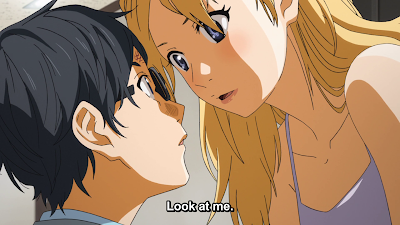
As good as the performance scene was, what struck me the most was the scene between Kaori and Kousei prior to the performance. The constant eye contact between the two, demonstrated through close-ups and extreme close ups, really showed their strong connection. The visuals also exceptionally complement the dialogue. The scene starts strong with a close-up of the two in order to immediately capture the viewers’ attention. The viewers are drawn to Kaori as much as Kousei. In effect, this made the dialogue sink in more as she tells Kousei to look at her and look up with more confidence. It then cuts to medium-long shot, which breaks the intimacy but in a good way since it slows the scene down for dramatic build up. This shot also gives the viewers an overall sense of their contrasting body language. Kousei is sitting stiffly with arms and hands still mimicking practicing the piano, while Kaori has a more relax posture. The medium-long shot was the build up for the extr...

Shigatsu wa Kimi no Uso (Your Lie in April) Episode 3

Image
The cinematography in this episode was a bit of a mixed bag. Although a bit too obvious, the use of desaturation to visually equate musical deafness to lacking color was a nice touch. There were also hints of this in the first episode. On the other hand, some of the compositions in this episode were shoddy. The first three images are examples of desaturated shots of Kousei that acted as visual metaphor to his loss of musical hearing. In contrast, Kaori was visualized brightly and colorfully, which reflects her bubbly personality and enthusiasm for music. Another nice touch was the change of the scenery from warm to cold colors after he revealed to Kaori his affliction.

Shigatsu wa Kimi no Uso (Your Lie in April) Episode 2

Image
Only days after the superb Shingeki no Bahamut dance scene, Shigatsu wa Kimi no Uso brought us another enjoyable performance scene. Kaori’s performance of the Kreutzer Sonata was brought to life by purposeful shot variety that gave viewers different vantage points of the performance. Here’s the scene: ________________________________________________________________________ Just like the Shingeki no Bahamut dance scene, Kaori’s violin scene uses multiple low angle shots to present the performance in a grander scale. These shots exude stage presence that was conducive in making this scene engrossing. The low angle shots were also done in varying sizes. The full shots presented Kaori’s body language while the closer shots showed her emotions. The shots from behind Kaori give the viewers the performer’s perspective. This perspective gives us an intimidating stage view of the venue, and aids in relating the nerves and exhilaration of performin...