Posts

6:45 a.m. SUN 31 August 2014

Image
This short movie conveys the nostalgic sentiments for old-fashion style and technology in a time of rapid progression. The vivid visual presentation has a comforting atmosphere that can be likened to visiting an old grandparents’ house. Watch the short below: The most impressive thing about this short is the finely detailed and wonderful background art that helped create a nostalgic mood. The excellent background work is brought to life by the immersive use of camera movement. The short movie aimed to immerse the audience both with the use of subjective (participant’s viewpoint) and objective (observer’s viewpoint) shots. Subjective shots were used to give the audience a first person point of view of the subject’s action. These shots created an illusion of trading places with the subject. Swiping the tablet to turn a page and going down the stairs to pick up a newspaper were seen through the subject’s eyes. Seeing these contrasting actions from a subjective view p...

Death Parade Episode 11

Image
The ice skating scene was absolutely fantastic and beautiful. I also liked the subtle sentimental moment between Decim and Chiyuki right before the performance. No words were said; it just used the piano in the background to connect the two characters. It started with a wide shot of Chiyuki with the piano in the background. This established the piano’s placement in the scene, in relation with the ice rink and the character. The shallow focus close-up shot of Chiyuki put a bit more emphasis on the piano. Its importance was still unclear due to being out of focus but this shot served more as a build-up. The gif showing the eyeline match between Decim and the piano is what established the piano’s significance. The camera zoomed out to finally put the piano in focus and then cut to the dummy playing. The sequence shown in the gif was important in connecting Decim and Chiyuki. The piano music was a sincere gesture of Decim’s desire to understand Chiyuki’s emotions and...

Shigatsu wa Kimi no Uso (Your Lie in April) Episode 21

Image
This was quite an emotionally heavy episode. The moments that emotionally stood out were the Kousei-Hiroko and the rooftop scenes but what really caught my attention was the hospital room scene between Kousei and Kaori. This scene effectively used framing and other compositional elements to create a distant mood that then shifts to one that’s more intimate. The scene starts off with an awkward and detached mood. Kousei avoids conversation and eye contact to distance himself from the pain of seeing the deteriorating health of Kaori. The two “two shots” above reflect this feeling of detachment. The three-quarter angle shot (first image) and the wide shot created distance between the two characters that conveyed a feeling of disconnect. This feeling of disconnect was further reinforced with the use surface division and dividing lines that visually separated the characters. The three-quarter shot staged Kousei against a white surface while Kaori was against a brown one. The wide...

The Tale of the Princess Kaguya

Image
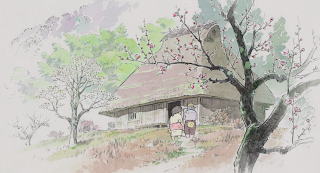
The Tale of the Princess Kaguya, directed by Isao Takahata, is a terrific retelling of the Japanese folktale The Tale of the Bamboo Cutter. The thematic foundation of the film is the pressure of social assimilation on individuality and the longing for a real home. These themes were powerfully reinforced through the film’s eloquent visual narrative. True Home The straw house the family initially resided in was featured prominently in the movie. This was to establish its eventual importance to Kaguya when she began desiring a simpler life away from the expectations and pressures of becoming a princess. Despite the lavishness of the new mansion, this quaint straw house was always home to her. It represented her happiest moments spent frolicking the woods with her father and among her friends. Another worth of note are the soft curves present in these shots. The shape of the house, the hill and the path are all curved. The film made a point to present these in order ...

Shigatsu wa Kimi no Uso (Your Lie in April) Episode 18

Image
This episode’s performance was a terrific coming of age for Nagi as a musician cross cut with Kaori’s bitter sweet violin pantomime. From a cinematography stand point, the performance scene mixes up the camera work in order to match the change in mood. The beginning moments of the scene were filled with slow pans, tilts, and tracking shots. These languid movements matched Nagi’s feeling of comfort and ease with her performance. For Kousei this wasn’t good enough and looked to push her further as a performer. He shifted the mood and tone of the performance and accordingly the camera work matched up with it. There were less camera movement and more low angle static shots of Kousei that gave him a more commanding presence (as seen below). This was a nice use of whip-pan to emulate Nagi’s willingness to keep up with Kousei’s pace. It appropriately expressed Nagi’s intensity but it was also brief enough not to be a distraction.

Garo: Honoo no Kokuin - Episode 18

Image
As Leon grieves the death of Lara, the pain of this loss causes his dark past to resurface. His past is haunting and tempting him to yet again to give in to a life of anger and vengeance. The visual of this scene uses spatial depth and the symbolism of footprints to convey his internal struggle. Footprints are physical marks of the past that show where we were and where we were going. With this notion in mind the footprints in this scene can symbolize Leon’s connection to his past, whether it was the vengeful life that he once lived or the life he spent with Lara. When showing Leon’s connection to his dark past, the footprints were shot in deep space. The three shots above demonstrate deep space with depth cues such as one point perspective and footprints receding in the distance. Deep space tends to be more visually intense, which accentuated the ominous nature of Leon’s shadow of the past. In contrast, Leon’s footprints connecting him to Lara were shot in flat s...

Muybridge's Strings

Image
Muybridge's Strings is a short film by Koji Yamamura telling parallel stories of Eadweard Muybridge’s life and a Mother’s life with her daughter. The connecting theme is time. Muybridge’s sequential photography captures moments in time and in a way the Mother desires to do similarly with her time with her daughter. ________________________________________________________________________ The first noticeable visual element is Eadweard Muybridge’s story was animated in black and white while the Mother’s story was in warm color. The primary purpose is to separate the past from modern day. The secondary purpose is to create a mood that befits their situation. The black and white palette fits Muybridge’s dark and tumultuous life. The warm color reinforces the feeling of love and affection between mother and daughter.